
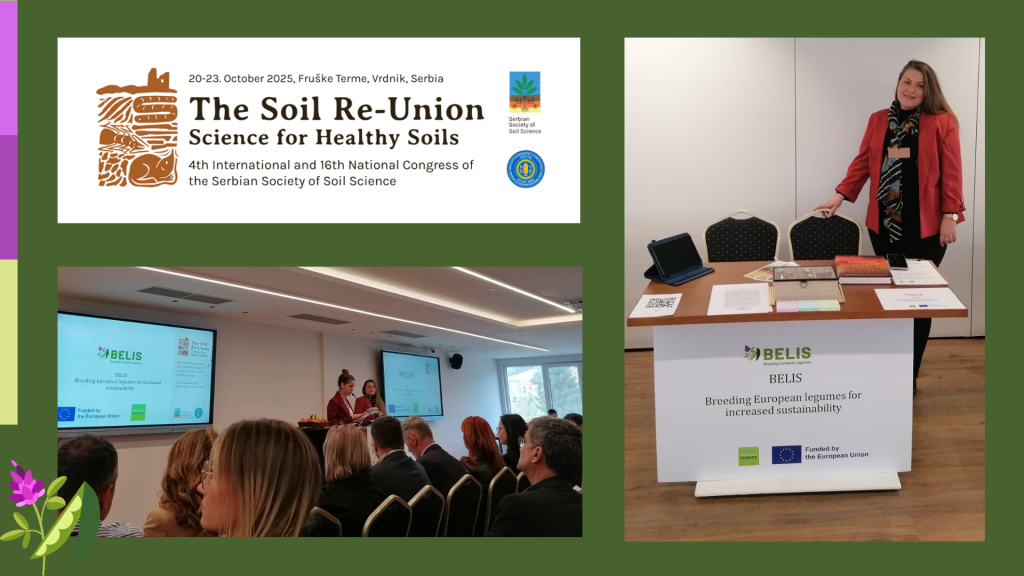
The BELIS project was represented at the 4th International and 16th National Congress of the Serbian Society of Soil Science, held under the theme «The Soil Re-Union: Science for Healthy Soils». Marjana Vasiljević from the Institute of Field and Vegetable Crops (IFVCNS) presented the project through an engaging booth presentation, joining 14 other soil science initiatives in showcasing cutting-edge research and innovation.
Fostering connections across disciplines
The Soil Re-Union provided an exceptional platform for networking and knowledge exchange, bringing together researchers from diverse regions and disciplines united by a common goal: promoting healthy soils. The event facilitated meaningful connections, the exchange of innovative ideas, and the exploration of potential synergies within the research community—perfectly aligned with BELIS’s collaborative spirit.
BELIS: Breeding European legumes for increased sustainability
During the congress, the BELIS project’s mission and achievements were highlighted, emphasising the critical role legumes play in sustainable agriculture. Both grain and forage legumes provide essential proteins for human and animal consumption while offering significant environmental benefits, particularly through symbiotic nitrogen fixation.
Addressing Europe’s legume gap
Despite their potential, legume cultivation in Europe has remained limited due to insufficient high-yielding and resilient varieties, leading to heavy reliance on imports of both legume grains and nitrogen fertilizers. BELIS is working to bridge this gap through advanced breeding methodologies and strong collaboration among research and industry stakeholders.
Project highlights
The project focuses on an impressive diversity of legume species, encompassing seven forage crops (lucerne, red clover, white clover, annual clovers, sainfoin, birdsfoot trefoil, and vetches) and seven grain crops (pea, faba bean, soybean, white lupin, lentil, chickpea, and common bean). This selection represents a major part of the diversity of legume species cultivated across Europe.
The project’s key objectives center on developing cost-effective breeding tools, improving the economic and regulatory environment for legume breeding, and ensuring efficient innovation transfer through collaborative public-private partnership platforms.
Launched in October 2023 under the European Union’s Horizon Europe programme, BELIS brings together a consortium of 34 partners from 18 countries. Coordinated by INRAE (Institut national de recherche pour l’agriculture, l’alimentation et l’environnement), the partnership includes research institutes, plant breeders, seed companies, registration offices, and advisory services.
IFVCNS’s contribution
The Institute of Field and Vegetable Crops (IFVCNS), as a National Institute of the Republic of Serbia, plays an active role in the BELIS project. The institute’s contributions span multiple areas, including developing advanced breeding tools and approaches, creating protocols for abiotic stress tolerance, and conducting phenotypic and molecular breeding proofs of concept. Additionally, IFVCNS is working on improving VCU (Value for Cultivation and Use) tests and protocols, while contributing to variety recommendations at the EU level for various legume crops.
The presentation at The Soil Re-Union underscored the vital connection between healthy soils and sustainable legume production, reinforcing BELIS’s commitment to building a robust foundation for the legume breeding community across Europe. Through continued collaboration and innovation, the project is paving the way for a more sustainable and self-sufficient European agricultural system.
