
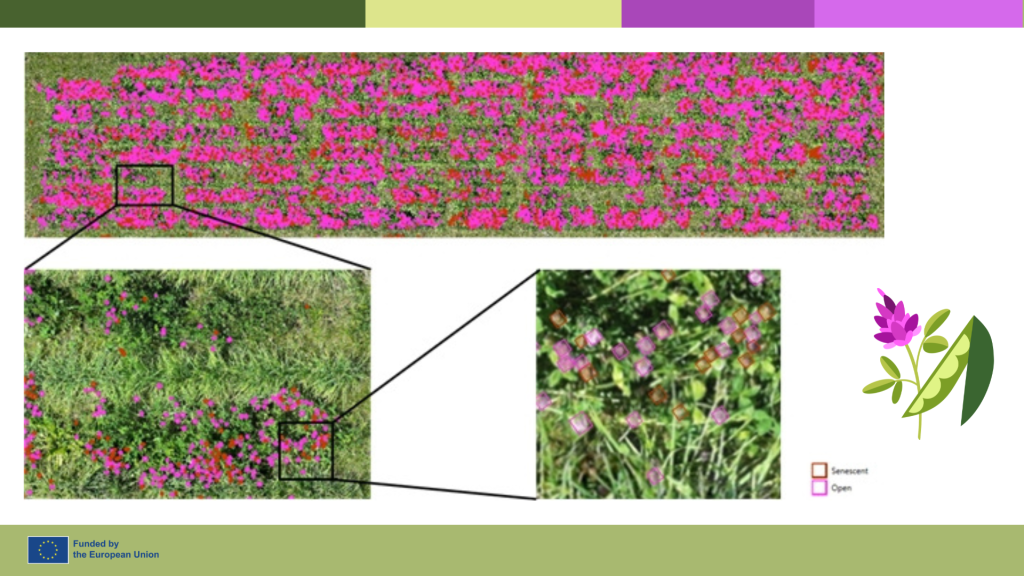
Satisfactory seed production is increasingly important for red clover cultivars to remain economically viable. Variable weather events, declining bumblebee populations, and difficulties in controlling insect pests are placing growing pressure on seed yields. To identify candidate varieties with good seed yield potential, breeders evaluate material in dedicated seed production trials — a process that is highly labour-intensive.
Flower head number per plot has been identified as a key factor influencing seed yield. Quick and reliable estimates of this trait could allow breeders to screen larger amounts of material without the need to harvest seeds on every plot. Within BELIS, ILVO (Flanders Research Institute for Agriculture, Fisheries and Food) and Agroscope are jointly optimising a model to estimate flower head numbers using UAV (unmanned aerial vehicle) imagery.
Data collection and model development
UAV time series of flowering red clover fields were collected by Agroscope, ILVO, DLF (Dansk Landbrugs Frøforsyning) Seeds, and DSV (Deutsche Saatveredelung). Using these data, two models were developed and optimised to detect both open (pink) and senescent (brown) flower heads: a baseline image analysis model and an AI-based model.
The AI model was built using YOLO (You Only Look Once), an open-source deep learning object detection framework. The model follows an active learning approach, whereby each training cycle incorporates new images to progressively improve predictive performance. The YOLO model currently achieves an F1 score of 92%, with remaining errors largely attributable to background confusion.
Validation against expert scoring
To further validate both models, an independent test set is being compiled, on which expert scoring will be conducted. Breeders from Agroscope, ILVO, Barenbrug, DLF Seeds, and DSV will score the images and assign flower density ratings on a 1-to-5 scale. These expert scores will be compared against the predictions of both models. The YOLO model is expected to outperform the baseline model, particularly in the detection of senescent flowers.
Towards practical application
In the final phase of the project, ILVO and Agroscope will support DLF Seeds, DSV, and any other interested partners in applying the model in practice, with the aim of increasing efficiency in their breeding programmes.
Authors: Arno Kasprzak (ILVO), Peter Lootens (ILVO), Tim Vleugels (ILVO), Michelle Nay (Agroscope), Ralph Stoop (Agroscope), Michael Simmler (Agroscope)
