
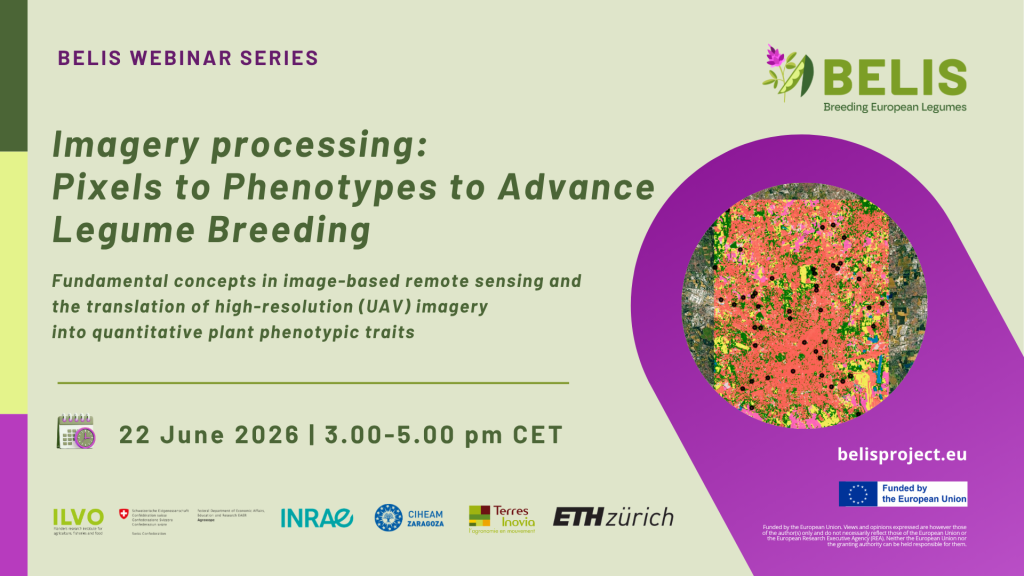
The BELIS Project is hosting a webinar on the use of image processing technologies to advance legume breeding.
Taking place on 22 June 2026, from 3:00 to 5:00 p.m. CET, the session will explore how high-resolution UAV imagery — combined with spectral analysis, spatial data, and artificial intelligence — enables non-destructive, time-efficient extraction of quantitative phenotypic information from crops. Presentations will cover core remote sensing concepts, the translation of pixel-level data into plot-level phenotypic traits, and the growing role of automation and vision-based AI in modern plant phenotyping. Practical case studies in lucerne, red clover, and pea will also be presented, comparing drone-based predictions with conventional manual phenotyping methods.
The webinar will likewise serve as an opportunity to learn more about the BELIS project, which focuses on 14 legume species across forage and grain crops, with the overarching goals of developing cost-effective breeding tools, improving the regulatory environment for legume breeding, and fostering innovation transfer among a broad network of stakeholders — from breeders and researchers to farmers and the feed and food industry.
The session is particularly relevant for plant breeders, phenotyping researchers, agronomists, remote sensing specialists, and data scientists working in agriculture and plant improvement, as well as for professionals involved in field trials, crop breeding programmes, and sustainable agriculture initiatives.
Registration deadline: 18 June 2026
Access the programme and register here
