
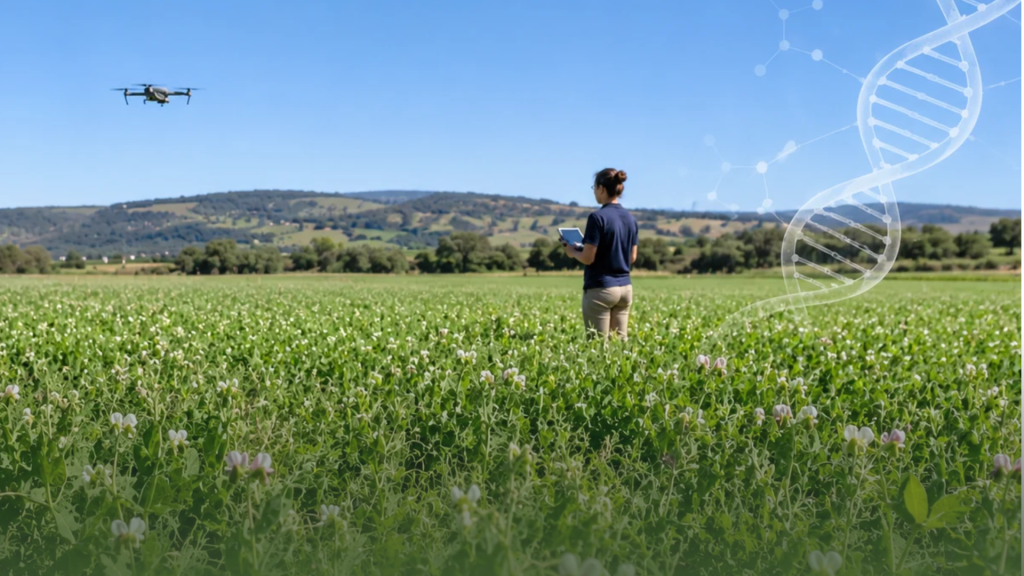
The BELIS project is offering a new training opportunity for legume breeders and researchers: the Advanced Course “Genotyping and phenotyping in legumes: Tools, data and decisions for legume breeding”. Organised by CIHEAM Zaragoza, it will take place face-to-face at IAS-CSIC in Córdoba, Spain, from 12 to 16 April 2027.
Legume breeding is being reshaped by advances in sequencing, remote sensing, image analysis and prediction models. At the same time, breeding programmes are often small and work with limited budgets, so choosing the right tools has real consequences for cost and accuracy. The course brings genotyping, phenotyping and the analytical methods that connect them into a single framework, applied to grain and forage legumes and to Mediterranean and European breeding contexts.
The programme follows the path a breeder actually takes: from the plant sample to the marker dataset and the selection decision, and from the field to the image and the trait value. Participants will explore genotyping and sequencing technologies, marker-assisted, genomic and phenomic selection, the design of phenotyping protocols, case studies on biotic stress, abiotic stress and quality traits, and high-throughput image-based phenotyping. Teaching combines lectures, guided debates, case studies, hands-on sessions with real legume datasets, a technical visit to the IAS-CSIC and IFAPA legume breeding trials in Córdoba, and final group work.
The course is coordinated by Joaquín Balduque (CIHEAM Zaragoza), Hilde Muylle (ILVO), scientific coordinator for genotyping, and Diego Rubiales (IAS-CSIC), scientific coordinator for phenotyping. Guest lecturers come from CREA, IAS-CSIC, UCO, IFAPA, INRAE, ILVO, Legume Generation and ICARDA.
Who can apply
The course is designed for 25 participants with a university degree: plant breeders from public institutions and from seed and breeding companies, researchers, PhD candidates, technicians of breeding and evaluation programmes, and advisors and practitioners from Mediterranean and European countries working in legume breeding, plant genetics, plant pathology, agronomy, crop phenotyping and variety evaluation. A basic background in quantitative genetics is assumed, and participants are asked to bring a laptop for the practical sessions.
Registration and financial support
There are no registration fees, but participants must cover their own travel and accommodation costs. Candidates from CIHEAM member countries, the European Union and neighbouring countries may receive financial support for travel and accommodation, with preference given to low- and middle-income countries. The deadline for applications and for requesting financial support is 13 December 2026.
More information, the programme and the online application form are available on the course page.
