
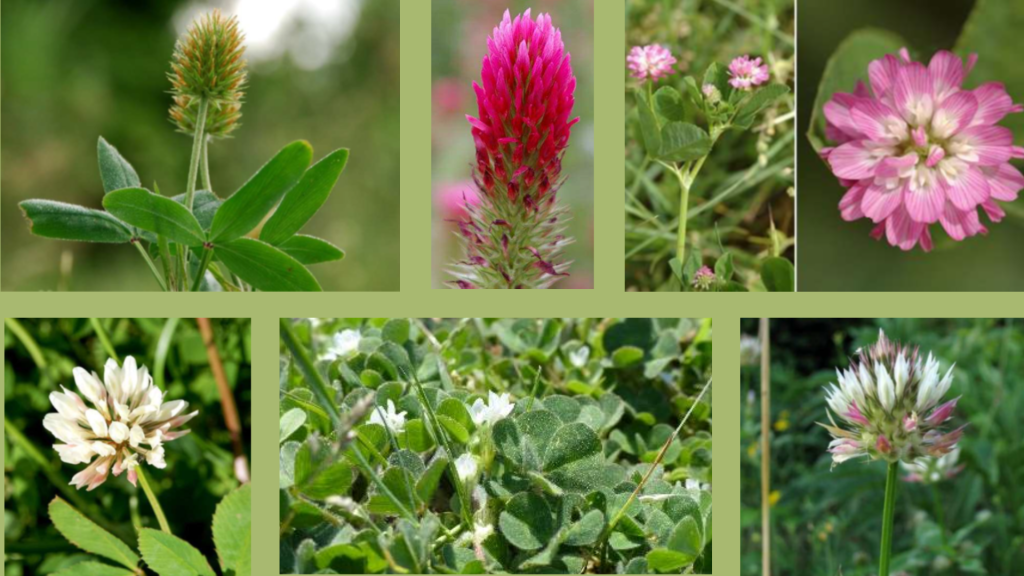
Annual clovers (Trifolium sp.) include a wide number of species used either as forage crops (sown in spring or in autumn) or as cover crops (sown in summer or autumn). Recent regulations requiring soil coverage between the harvest time of a cash crop and the sowing time of the next crop (autumn or spring), are encouraging the use of cover crops, which provide ecosystem services such as nitrogen sequestration or fixation and soil conservation. When annual clovers are used, the biomass obtained before the next cash crop sowing can be harvested as forage or left in the field as green manure. In both cases, the biochemical composition of the biomass affects its value. The biochemical composition of annual clovers is poorly described, and any breeding programme that aims at increasing the nutritional value of annual clovers requires NIRS equations. After having tested that lucerne or red clover equations were not correctly predicting annual clovers, INRAE developed new equations to predict biochemical composition of annual clovers.
About 220 samples of annual clovers (T. incarnatum, T. michalianum, T. resupinatum, T. squarrosum, T. subterraneum, T. vesiculosum) were collected at two sites, with a total of three trials sown in either spring or autumn, with different harvest dates in spring, summer or autumn. Samples were dried and ground to pass a 1 mm sieve and NIRS spectra were collected on a Brucker instrument with three repetitions. NDF, ADF and protein contents, as well as digestibility were measured on the samples with two repetitions. A subset of 193 samples was used to develop specific NIRS equations that were used to predict a test set consisting of the remaining 34 samples. The predictions were compared with the measurements.
With the newly developed equations based on annual clovers, R² was 0.96 for NDF content, 0.89 for ADF content and 0.98 for protein content, and the bias were close to 0. More samples, covering a wide range of sites, seasons and stages, will progressively enrich the equations. This offers the prospect of developing NIRS equations to predict the biochemical composition of annual clovers for use in breeding programmes and variety evaluation.
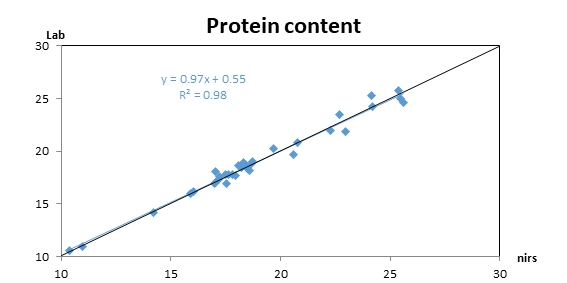
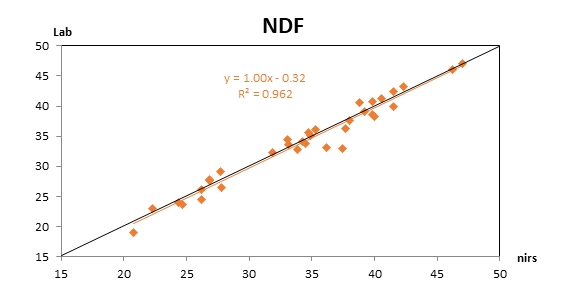
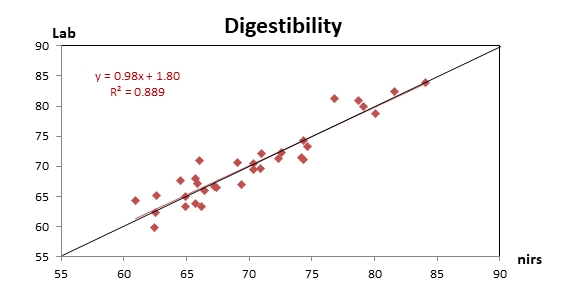
Comparison of biochemical composition contents (% of dry matter) measured in the lab and predicted by an annual clover equation
