
Within the BELIS project, four plant breeding companies are collaborating with INRAE (Institut National de Recherche pour l’Agriculture, l’Alimentation et l’Environnement — French National Research Institute for Agriculture, Food and Environment) to compare two approaches to lucerne (Medicago sativa) breeding: the traditional method, based on phenotypic evaluation, and an innovative method in which plant selection is guided by traits predicted using a genomic prediction equation developed by INRAE
Experimental design
The breeders from Barenbrug, Cérience, DLF (Dansk Landbrugs Frøforsyning) Seeds, and RAGT-2N (the research subsidiary of RAGT Semences) have each independently selected their preferred plants within their own nurseries and crossed them to produce the first SYN1 (first synthetic generation) — the initial generation of a synthetic variety, obtained by intercrossing a defined set of selected parent plants.
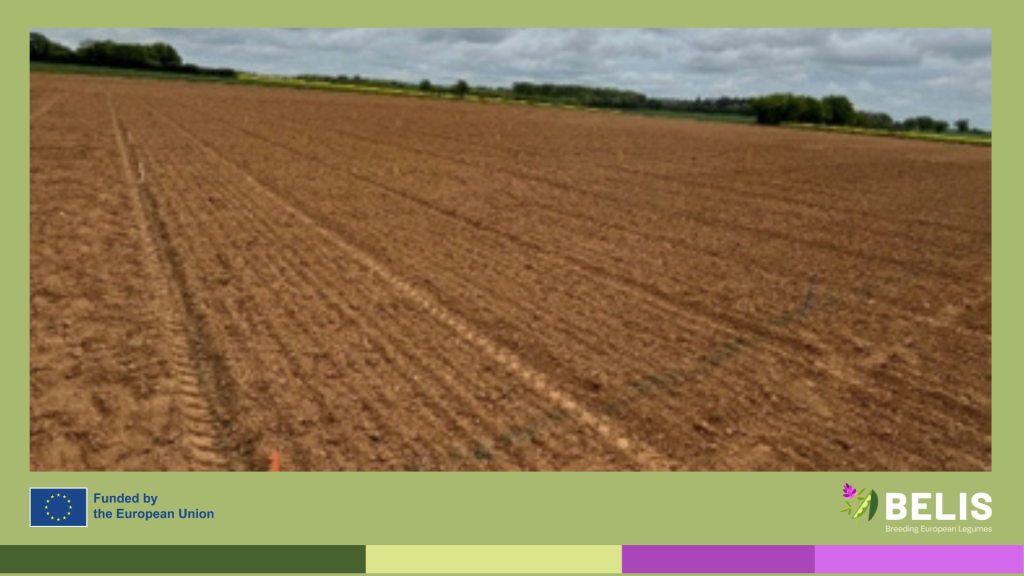
All experimental populations, along with control varieties, have been sown at INRAE’s URP3F (Unité de Recherche Pluridisciplinaire Prairies et Plantes Fourragères — Multidisciplinary Research Unit on Grasslands and Forage Crops) in Lusignan, France. In parallel, each breeder has sown their own material at their respective locations, enabling evaluation across multiple environments.
What comes next
The seeds are now emerging. Results on forage yield and biochemical composition are expected within the next two years, at which point a conclusion can be drawn on this proof of concept — and on the potential of genomic prediction to complement or enhance traditional phenotypic selection in lucerne breeding.
