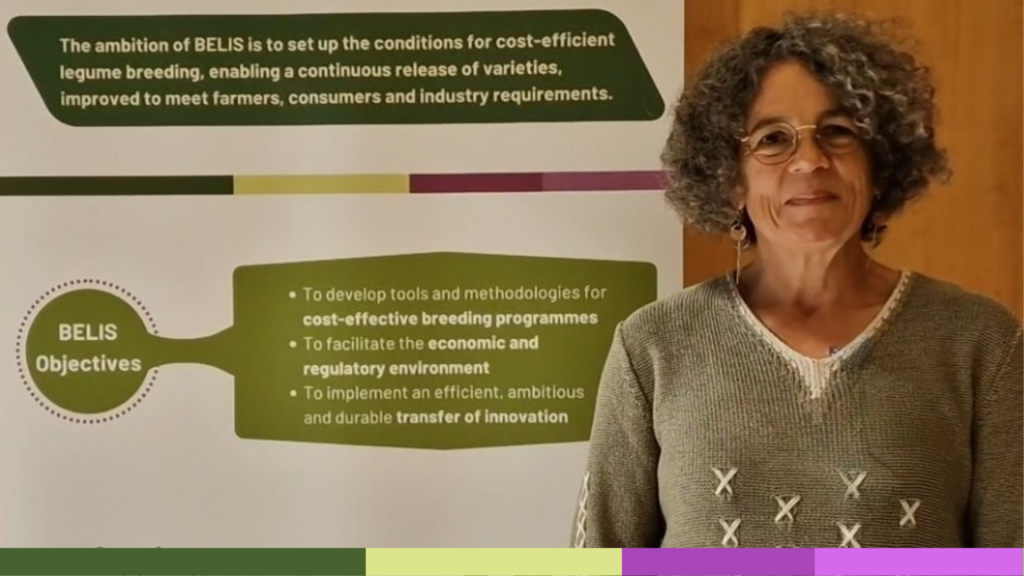
On the occasion of the World Pulses Day, we interviewed BELIS Project Coordinator Bernadette Julier, Research Director at the French National Institute for Agriculture, Food, and Environment (INRAE). Her work focuses on the genetics of forage legumes, particularly lucerne (alfalfa), with the goal of improving agricultural sustainability through protein autonomy, increased nitrogen fixation, and reduced pesticide use.
Why are legumes so important for sustainable agriculture and our food systems, and what inspired the creation of the BELIS project?
Legumes are unique for their ability to fix atmospheric nitrogen and to transform it into protein. They also enrich soils in nitrate, making it available for other crops, either associated with legumes or in rotations. In addition, plant proteins are valuable in human diets for their positive health impacts, and also for animal feeding. Unfortunately, legume crops in European agriculture are not predominant enough to provide these benefits on a broad scale and therefore the EU is importing proteins from abroad for animal feed and human food. Farmers often complain that legume cropping is not as profitable as grain crops, and even for forage production, they often find it easier to add nitrogen fertilisers to grasslands than to grow legume-rich grasslands. BELIS aims to accelerate legume breeding in order to provide improved, profitable, and well adapted legume varieties for farmers.
What are the main breeding priorities BELIS is addressing to make legumes more competitive and attractive for European farmers, both as grain crops and forage?
Yield, quality, disease and pest resistance, adaptation to frost and drought are recurrent breeding objectives for the main legume crops, but more genetic progress is still required. These same traits are also important for minor legume crops that offer specific adaptation features to climate, soil or use. In addition, studies are being conducted in BELIS on new quality traits, and resistance to emerging pathogens and pests.
How is BELIS integrating modern breeding techniques with traditional approaches to accelerate the development of new legume varieties? Are there any particularly promising innovations emerging from the project?
Molecular breeding has proven efficiency in many plants and animals but is still under-used in legumes. Development of molecular tools, identification of trait-associated markers, and ability to predict traits from sets of markers through genomic selection are emerging innovations. Phenotyping tools are also useful to better describe trait variation in large collections of genotypes. Cooperation between researchers and breeders is promising to release genetic innovations. BELIS is tackling this objective, with experimental breeding schemes as proof of concept to show that genetic progress can be much improved when combining the best tools for phenotyping and genotyping in breeding processes.
As we celebrate World Pulses Day, what message would you like to share about the future of legumes in our diets and on our farms?
The positive impacts of legumes in the “One Health” objective have to be understood by society and shared. Legumes are an excellent, tasty and healthy food. They are an excellent feed —either as grain or forage— for dairy cows, pigs, poultry, and others. Legumes are also an excellent source of reactive nitrogen in the field, that save fossil energy otherwise used to produce chemical nitrogen fertilisers, and thus limit nitrogen pollution in water and air.
World Pulses Day 2026 will be celebrated globally on 10 February, marking the annual United Nations observance that promotes the nutritional, environmental, and sustainable farming benefits of pulses like beans, lentils, chickpeas, and peas, highlighting their role in food security and healthier agrifood systems