
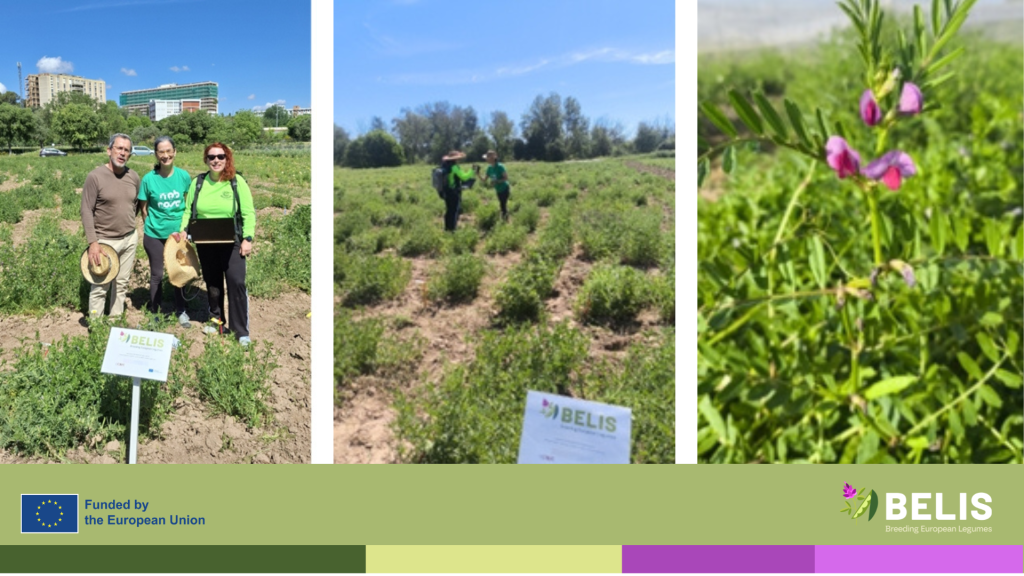
As part of the collaborative framework of the BELIS project, researchers from ITQB NOVA (Instituto de Tecnologia Química e Biológica António Xavier — Institute of Chemical and Biological Technology António Xavier, part of NOVA University of Lisbon, Portugal) once again joined colleagues at IAS-CSIC (Instituto de Agricultura Sostenible del Consejo Superior de Investigaciones Científicas — Institute for Sustainable Agriculture of the Spanish National Research Council) in Córdoba, Spain, during April, to evaluate approximately 300 accessions of vetch (Vicia sativa) using the Portable Spectroradiometer FieldSpec4 (Malvern Panalytical).
This was already the third consecutive year of joint measurements using this technology, reflecting a well-established and productive collaboration between the two teams. The FieldSpec4 enables detailed characterisation of spectral signatures across the VIS–NIR–SWIR range — spanning the Visible (350–700 nm), Near-Infrared (700–1300 nm), and Short-Wave Infrared (1300–2500 nm) portions of the electromagnetic spectrum — providing a comprehensive picture of plant optical properties.
A rich source of plant trait data
The spectral data collected will support the calculation of a wide array of plant indices linked to key physiological and biochemical traits. These include photosynthetic pigments such as chlorophylls, carotenoids, anthocyanins, and flavonoids, as well as nitrogen and water content, and structural components such as cellulose and lignin. The dataset also captures indicators of plant stress responses, biomass, and overall plant greenness.
The continued development of this large-scale dataset reinforces the potential of spectroscopy-based approaches for rapid, non-destructive assessment of plant performance — an increasingly valuable capability in high-throughput breeding contexts.
Complementing agronomic characterisation for vetch breeding
The FieldSpec4-based plant indices will complement the ongoing agronomic, disease, and pest resistance characterisation carried out by the Spanish team at IAS-CSIC, providing additional layers of information to support vetch breeding within the BELIS project.
